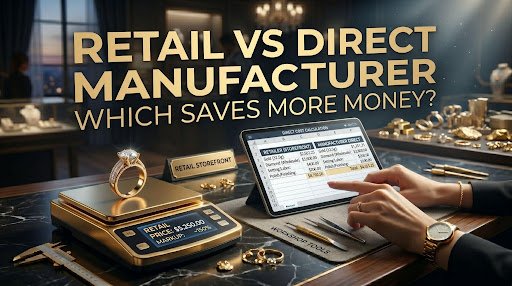
Retail vs Direct Manufacturer: Which Saves More Money?
In 2026, the way consumers purchase high-value products—especially jewelry—has undergone a significant transformation. Buyers are no longer dependent solely on retail showrooms for trust and accessibility. With access to global sourcing, digital design tools, and transparent pricing models, individuals are now asking a far more strategic question:
Why pay retail markup when you can buy directly from the manufacturer?
Understanding this shift requires a deeper look into pricing structures, supply chains, and the growing influence of manufacturer-to-consumer models.
Understanding the Core Difference: Retail vs Direct Manufacturer
At a fundamental level, the distinction is straightforward:
- Retailers sell finished jewelry products with multiple added margins
- Manufacturers produce jewelry and increasingly sell directly to individual buyers
While this difference appears simple, its impact on final pricing is substantial—often determining whether a buyer overpays or optimizes value.
Why Retail Jewelry Pricing Is Higher
When purchasing from a retail store, the price includes far more than just the product itself. Retail pricing is layered with multiple operational and branding costs, including:
- Premium Showroom Rents in Metro Cities
Retail jewelry stores are often located in high-end commercial areas where rental costs are extremely high. These expenses are directly added to product pricing, significantly increasing the final cost for buyers.
- Brand Positioning and Perceived Value
Established jewelry brands invest heavily in creating a premium image. Customers often pay extra for the brand name, reputation, and perceived exclusivity—rather than the intrinsic value of the product itself.
- Sales Staff Salaries and Commissions
Retail operations require trained sales professionals, whose salaries, incentives, and commissions are factored into the overall pricing structure.
- Inventory Storage and Unsold Stock Risk
Retailers maintain large inventories to offer variety. However, unsold stock, storage costs, and design depreciation add financial risk, which is ultimately passed on to customers.
- Marketing, Advertising, and Influencer Promotions
From digital campaigns to celebrity endorsements, retail brands spend heavily on marketing. These promotional costs are embedded in product prices, contributing to higher markups compared to direct manufacturer sourcing.
These cumulative expenses often result in 2x to 4x markup over the actual production cost. This is a key factor behind rising concerns around retail jewelry pricing transparency.
How Direct Manufacturer Pricing Works
In contrast, buying directly from a manufacturer offers a far more streamlined pricing model. You primarily pay for:
- Raw Materials (Gold, Silver, Vermeil, Gemstones)
This is the primary cost driver in any jewelry piece. The final price depends on metal purity (e.g., 18K, 22K), weight, and the type and quality of gemstones selected. Direct sourcing ensures you pay closer to actual market rates without inflated retail markups.
- Skilled Craftsmanship and Labor
Jewelry manufacturing involves expert artisans who handle design detailing, stone setting, polishing, and finishing. This cost reflects the level of precision, experience, and time invested in creating a high-quality piece.
- Production and Operational Overhead
These include factory-level expenses such as equipment usage, CAD/CAM design processes, utilities, and day-to-day operations. While necessary, these costs are significantly lower than retail overheads like showroom rent and large-scale marketing.
- A Reasonable Factory Margin
Manufacturers add a fair margin to sustain operations and profitability. However, this margin is typically much lower than cumulative retail markups, ensuring better value for the end buyer.
There are no unnecessary intermediaries inflating the price. As a result, buyers can typically achieve 30% to 70% cost savings, especially when opting for custom jewelry.
The Rise of Manufacturer-to-Consumer Jewelry Brands
One of the most important shifts in the modern jewelry market is the emergence of direct-to-consumer manufacturer brands.
Traditionally, manufacturers only catered to wholesalers or large retail chains. Today, that model has evolved. Many jewelry manufacturers now offer:
- Low MOQ (Minimum Order Quantity) options—even single-piece orders
- Direct consultation for custom jewelry design
- CAD (Computer-Aided Design) previews before production
- Flexible material selection based on budget
This evolution has made custom jewelry manufacturing accessible to individual buyers, not just businesses.
Real-Life Comparison: Retail vs Manufacturer Buying
Retail Purchase Scenario
A buyer visits a jewelry showroom for a custom ring:
- Limited design flexibility
- Fixed pricing structure
- Heavy brand markup
- Final price: ₹90,000
- Immediate purchase
Direct Manufacturer Purchase Scenario
The same buyer connects with a manufacturer:
- Shares design inspiration
- Receives CAD and 3D previews
- Selects metal and stone based on budget
- Final price: ₹50,000 – ₹65,000
- Delivery time: 10–15 days
What’s the Difference?
The quality remains comparable. The key difference lies in eliminating supply chain markups—allowing the buyer to pay closer to the actual product value.
Key Reasons Why Buying Direct Saves More Money
1. Elimination of Middlemen Margins
Every intermediary adds a profit layer. Removing them significantly reduces overall cost.
2. Budget-Based Customization
Unlike retail, manufacturers allow buyers to:
- Adjust metal weight
- Select gemstone quality
- Modify design complexity
This gives buyers complete control over pricing.
3. Transparent Pricing Structure
Modern manufacturers often provide:
- Material breakdowns
- Cost clarity for design and production
- Defined delivery timelines
This transparency is rarely available in traditional retail environments.
4. Higher Value for the Same Budget
Instead of paying for branding, buyers can invest in:
- Better craftsmanship
- Higher-quality materials
- More intricate and personalized designs
Why Retail Still Exists (And When It Makes Sense)
Despite the cost advantages of direct sourcing, retail continues to play a role in the market. Buyers often choose retail when:
- Immediate purchase is required
- Physical inspection of the product is preferred
- Brand trust outweighs cost concerns
- The purchase is emotionally driven (e.g., gifting, weddings)
Retail offers convenience and instant gratification, but typically at a higher price.
Smart Buying Strategy in 2026
Today’s informed buyers are adopting a hybrid and research-driven approach:
- Analyze product specifications (metal purity, gemstone quality)
- Compare retail jewelry pricing vs direct manufacturer pricing
- Shortlist reliable custom jewelry manufacturers in India
- Evaluate customization options
- Make a value-based purchase decision
How to Safely Buy from Manufacturer-to-Consumer Brands
To maximize benefits, buyers must follow a structured approach:
Verify Manufacturer Credibility
Check for:
- Established business presence
- Portfolio of past work
- Genuine customer reviews
Request Design Validation
Ensure the manufacturer provides:
- CAD designs
- 3D visual previews
- Detailed specifications
Confirm Material Details
Always verify:
- Metal purity (e.g., 18K, 22K gold)
- Stone authenticity and grading
- Final product weight and dimensions
Start with a Single Order
If uncertain, begin with one custom piece before scaling further.
The Hidden Advantage: Control, Not Just Cost
While cost savings are significant, the real benefit of buying directly from manufacturers is complete control.
Buyers gain control over:
- Design Customization
Buyers now have the freedom to create jewelry that aligns with their exact vision. From selecting unique patterns to modifying existing designs, customization ensures the final piece is personal rather than mass-produced.
- Material Selection
Direct sourcing allows individuals to choose materials based on both preference and budget. Whether it’s gold, silver, vermeil, or specific gemstone grades, buyers can control the overall quality and cost of the product.
- Budget Allocation
Instead of accepting fixed retail pricing, buyers can distribute their budget strategically—prioritizing elements like stone size, metal weight, or craftsmanship. This flexibility helps in achieving better value without overspending.
- Final Product Outcome
With involvement at every stage—from design approval to material selection—buyers have greater control over how the final piece turns out. This reduces uncertainty and ensures the product meets expectations in terms of both quality and aesthetics.
Retail limits these choices, whereas manufacturers expand them.
When Should You Choose Direct Manufacturer?
Direct sourcing is ideal when:
- You want maximum value for your budget
- You prefer custom jewelry designs
- You are comfortable with a short production timeline
- You are willing to research before purchasing
When Retail Might Be the Better Option
Retail is still suitable if:
- You need the product immediately
- You prefer in-store shopping experiences
- You are not interested in customization
- Brand perception is a priority
The Future of Jewelry Buying: Direct from Manufacturer
The global jewelry market is rapidly shifting toward manufacturer-to-consumer models. This change is driven by:
Evolving Buyer Behavior
- Increased Awareness of Pricing Structures
Today’s buyers are far more informed about how jewelry pricing works. They actively research components like gold rates, gemstone quality, and making charges before making a purchase. This awareness helps them identify inflated retail markups and make more cost-efficient decisions.
- Growing Demand for Transparency
Modern consumers expect clear and honest pricing. They prefer brands that openly share material breakdowns, labor costs, and production timelines. This shift is pushing the industry toward more transparent business models, especially in direct manufacturer-to-consumer relationships.
- Strong Preference for Personalized Designs
Customization has become a major buying driver. Instead of choosing mass-produced designs, buyers now want jewelry that reflects their personal style, story, or occasion. Direct manufacturers cater to this demand by offering flexible design options, material choices, and made-to-order production.
Manufacturer Adaptation
- Low MOQ Production Capabilities
Modern jewelry manufacturers now offer low minimum order quantity (MOQ) production, allowing individuals to order even a single customized piece. This eliminates the traditional barrier where manufacturing was limited to bulk orders, making high-quality, factory-level jewelry accessible to personal buyers.
- Direct Customer Consultation
Instead of going through retailers or intermediaries, buyers can now communicate directly with manufacturers. This enables better clarity on design, pricing, and materials, while also allowing personalized recommendations based on budget and preferences.
- Advanced Design Technology (CAD/CAM)
With the use of CAD (Computer-Aided Design) and CAM (Computer-Aided Manufacturing), manufacturers provide precise design previews before production begins. Buyers can visualize their jewelry in 3D, request modifications, and ensure the final product matches their expectations—reducing errors and improving overall satisfaction.
This shift is effectively bridging the gap between factory pricing and individual buyers.
Final Verdict: Which Saves More Money?
If your primary goal is cost efficiency without compromising quality, then:
Buying directly from a manufacturer is the smarter choice in most cases.
However, the real advantage goes beyond savings—it lies in value optimization.
You’re not just spending less.
You’re getting significantly more for what you pay.
Conclusion: Buy Smarter by Buying Closer to the Source
The modern buyer mindset has evolved:
Don’t just ask where to buy—ask where it is made.
With the rise of direct-to-consumer jewelry manufacturing, individuals can now access:
- Transparent pricing models
- Full customization capabilities
- Better material value
- Factory-level craftsmanship
By exploring options like custom jewelry manufacturer India, direct from manufacturer jewelry pricing, low MOQ jewelry manufacturing, and private label jewelry manufacturing, buyers can unlock far greater value than traditional retail channels.
Platforms like Nakassi are helping bridge this gap—connecting individuals directly with trusted manufacturers—making it easier than ever to buy smarter, not just cheaper.
Frequently Asked Questions (FAQs)
1. Is buying jewelry directly from a manufacturer cheaper than retail?
Yes, in most cases. Buying directly from a manufacturer eliminates multiple middlemen and retail overhead costs, allowing you to save anywhere between 30% to 70% compared to traditional retail pricing.
2. Does lower price from manufacturers mean lower quality?
No. The price difference is primarily due to the supply chain structure, not quality. Many manufacturers produce jewelry for top brands, so you’re often getting the same craftsmanship—just without the retail markup.
3. Can I order a single piece from a jewelry manufacturer?
Yes. With the rise of low MOQ (Minimum Order Quantity) models, many manufacturers now accept single custom orders, making it accessible for individual buyers.
4. How does customization work when buying directly?
Manufacturers typically offer full customization, including:
- Design selection or creation
- CAD/3D previews before production
- Choice of metal (gold, silver, vermeil)
- Selection of gemstones and quality
This allows you to tailor the product based on your budget and preferences.
5. Is it safe to buy jewelry directly from a manufacturer?
Yes, if proper research is done. Always:
- Verify the manufacturer’s credibility
- Check reviews and past work
- Request CAD designs and specifications
- Confirm material quality and certifications
6. Why is retail jewelry more expensive?
Retail pricing includes multiple additional costs such as:
- Showroom rent
- Branding and marketing
- Sales staff commissions
- Inventory and storage risks
These factors significantly increase the final price.
7. How long does it take to receive a custom piece from a manufacturer?
Typically, it takes 10 to 20 days, depending on the complexity of the design and production process. Unlike retail, where products are ready-made, manufacturing involves made-to-order production.
8. What are the risks of buying directly from a manufacturer?
The main risks include:
- Choosing an unreliable supplier
- Miscommunication in design expectations
- Delays in production
These risks can be minimized with proper research and clear communication.
9. When should I choose retail over a manufacturer?
Retail is a better option if:
- You need the product immediately
- You prefer to see and try the product physically
- You are not interested in customization
10. What is the biggest advantage of buying directly from a manufacturer?
Beyond cost savings, the biggest advantage is control—over design, materials, budget, and final output. You get a product tailored to your exact requirements rather than choosing from pre-made options.
11. Can I get better value for the same budget through a manufacturer?
Absolutely. Instead of paying for branding, your budget goes into:
- Better materials
- Larger or higher-quality stones
- More detailed craftsmanship
12. What should I check before placing an order with a manufacturer?
Before finalizing, ensure:
- Metal purity (e.g., 18K, 22K)
- Stone authenticity and grading
- Product weight and dimensions
- Final CAD design approval
- Delivery timeline