From Idea to Jewelry: How Customization Works (CAD, Wax, Final Product)
Custom jewelry is no longer a niche luxury—it has become a mainstream choice for buyers who want personalization, better value control, and unique designs. In 2026, more consumers are shifting from ready-made retail jewelry to manufacturer-direct customization, where every piece is created from scratch based on individual preference.
But how does an idea in your mind actually become a finished gold ring, chain, or bracelet?
The process typically moves through three major stages: CAD design, wax modeling, and final production. Each step plays a critical role in shaping the final look, durability, and pricing of your jewelry.
Key Takeaways
- Custom jewelry is a structured process that transforms an idea into a finished product through CAD design, wax modeling, casting, and finishing.
- CAD design provides a precise 3D preview, helping buyers visualize and refine their jewelry before production begins.
- Wax models act as physical prototypes to test size, comfort, and structure before final metal casting.
- Pricing in custom jewelry depends mainly on design complexity, metal weight, stone quality, and making charges.
- Manufacturer-direct customization offers better pricing transparency and more control compared to retail jewelry.
- Custom jewelry is ideal for buyers seeking personalization, uniqueness, and better value control over standardized designs.
What Is Custom Jewelry and Why Is It Growing?
Custom jewelry refers to pieces designed specifically for a buyer rather than selected from pre-made collections. Instead of choosing from limited showroom inventory, you define:
- Design concept
This is the foundation of custom jewelry creation. It defines the overall idea, style, and inspiration behind the piece—whether it is minimalist, traditional, modern, or luxury-focused. A clear concept ensures the final design matches the buyer’s vision.
- Metal type and purity
The choice of metal (gold, platinum, etc.) and its purity level (such as 14K, 18K, or 22K) directly impacts durability, color, and price. Higher purity offers richer value, while lower karats provide better strength for daily wear.
- Weight and size
Weight determines the actual material cost, while size affects comfort and usability. Larger or heavier pieces increase pricing, whereas lightweight designs are more practical for everyday use and budget-friendly.
- Stone setting and detailing
This includes how diamonds or gemstones are placed and secured in the jewelry. Different settings like prong, bezel, or channel affect both appearance and durability, while intricate detailing increases craftsmanship time and overall cost.
This shift is driven by:
- Demand for personalization
Modern buyers increasingly want jewelry that reflects their personal identity, style, and story. Instead of mass-produced designs, they prefer pieces that are uniquely tailored to their taste, making customization a key driver of demand.
- Better pricing transparency from manufacturers
Manufacturer-direct jewelry allows buyers to clearly understand what they are paying for—gold value, making charges, and design costs. This transparency builds trust and reduces the hidden markups commonly found in retail pricing.
- Social media influence (unique, aesthetic designs)
Platforms like Instagram and Pinterest have reshaped jewelry trends by promoting visually distinctive and aesthetic designs. Buyers are now inspired by influencers and global styles, leading to higher demand for unique, photo-ready jewelry pieces.
- Preference for meaningful, one-of-a-kind jewelr
Many consumers now choose jewelry with emotional or symbolic value, such as personalized gifts or custom-made pieces. This shift emphasizes individuality and long-term sentimental importance over generic, mass-market designs.
Custom jewelry allows buyers to control both design and cost structure, making it increasingly popular among modern consumers.
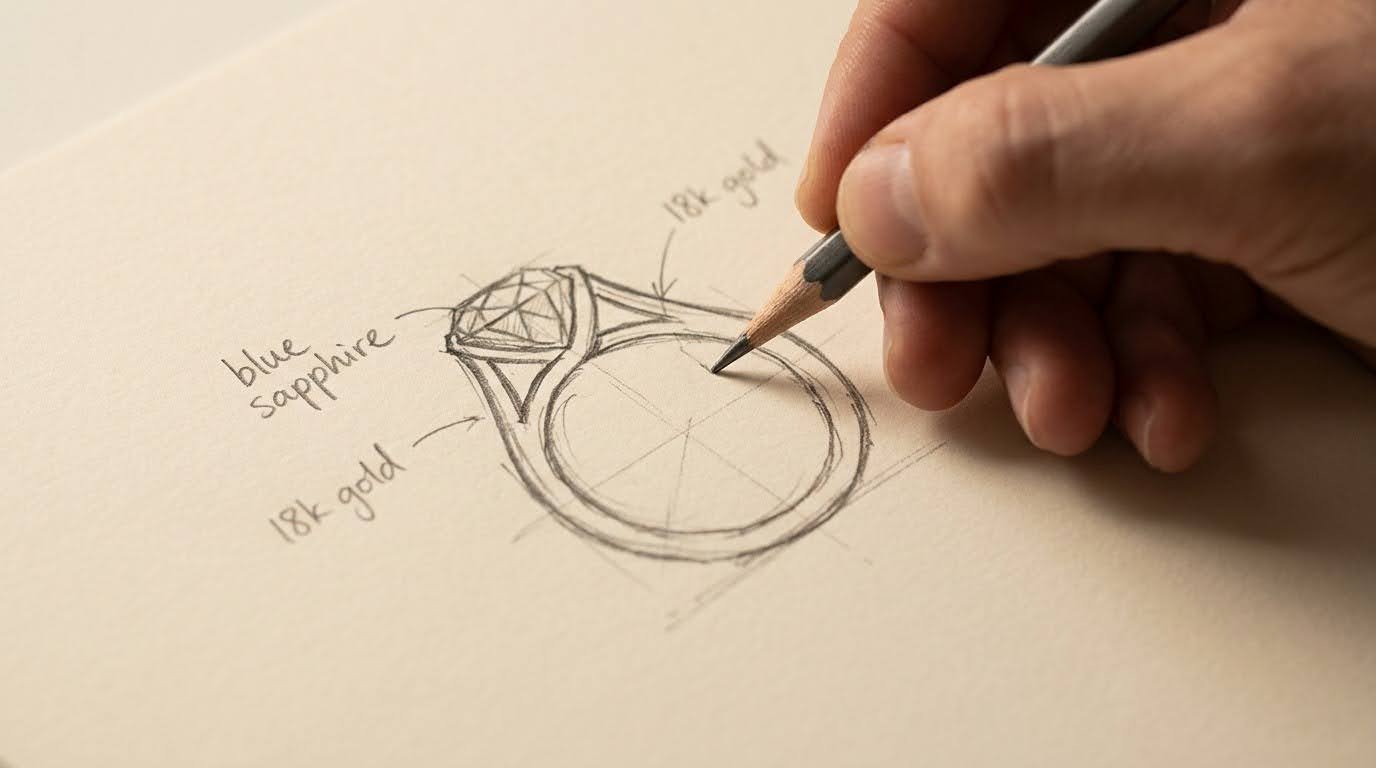
Step 1: Idea Concept and Design Brief
Every custom jewelry piece starts with an idea.
This stage includes:
- Sketching or reference images
- Choosing jewelry type (ring, chain, bracelet, pendant)
- Defining style (minimalist, luxury, traditional, modern)
- Selecting metal (gold, platinum, etc.)
At this point, buyers also decide:
- Budget range
- Gold purity (14K, 18K, 22K)
- Stone type and quality (if applicable)
A clear design brief ensures smoother execution in later stages and reduces redesign costs.
Step 2: CAD Design (Computer-Aided Design)
Once the idea is finalized, it is converted into a CAD model.
What is CAD in jewelry?
CAD (Computer-Aided Design) is a 3D digital representation of your jewelry piece created using specialized software.
Why CAD is important:
- Provides exact visual preview before production
- Allows changes in design before manufacturing
- Ensures accurate measurements and proportions
- Reduces production errors
At this stage, you can modify:
- Thickness and weight
- Stone placement
- Shape and detailing
CAD ensures the customer knows exactly what the final product will look like before production begins.
Step 3: Wax Model Creation
After CAD approval, the design moves into physical modeling.
What is a wax model?
A wax model is a 3D physical prototype created from the CAD design using wax-like material or resin.
Purpose of wax modeling:
- Validates design in real form
- Checks size, comfort, and structure
- Helps identify design flaws before casting
This step is critical because it ensures:
- Proper fitting (especially for rings and bracelets)
- Structural strength
- Real-world appearance validation
If changes are needed, adjustments are made at this stage before final metal casting.
Step 4: Casting and Metal Formation
Once the wax model is approved, it is used to create the final jewelry piece through casting.
How casting works:
- Wax model is placed in a mold
- Wax is melted away
- Molten gold or metal is poured into the cavity
- The metal takes the exact shape of the design
This process ensures:
- Precision replication of CAD design
- Structural integrity
- Consistency in production
Step 5: Stone Setting and Detailing
If the jewelry includes diamonds or gemstones, they are set after casting.
Types of stone settings:
- Prong setting (most common, holds stones with metal claws)
- Bezel setting (metal surrounds the stone)
- Channel setting (stones placed in a groove)
Each setting affects:
- Security of stones
- Visual appeal
- Final pricing
Step 6: Polishing and Finishing
This stage defines the final appearance of the jewelry.
It includes:
- Surface polishing for shine
- Edge smoothing for comfort
- Texture finishing (matte, glossy, etc.)
- Quality inspection
A well-finished piece enhances both aesthetic value and durability.
How Customization Affects Jewelry Pricing
Custom jewelry pricing is influenced by multiple factors:
- Design complexity → More detailed designs increase cost
The more intricate and detailed a jewelry design is, the more time, skill, and precision it requires. This increases labor effort and overall making charges, resulting in a higher final price.
- Metal weight → Higher weight increases total price
Jewelry pricing is directly tied to the amount of metal used. Heavier pieces contain more gold or precious metal, which significantly increases the base material cost.
- Stone selection → Quality and size of diamonds/gems impact pricing
The value of jewelry increases with better-quality and larger stones. Factors like clarity, cut, color, and carat weight all play a major role in determining the final cost.
- Making charges → Labor and craftsmanship costs vary based on design
Making charges depend on the complexity of craftsmanship involved. Simple designs have lower charges, while detailed or custom work requires more skilled labor, increasing the overall cost.
Unlike branded jewelry, customization allows better control over these cost elements.
Why Manufacturer-Direct Custom Jewelry Is Gaining Popularity
More buyers are choosing manufacturer-direct customization because it offers:
- Transparent pricing without retail markup
Manufacturer-direct customization removes retail layers like showroom costs, branding, and distributor margins. This gives buyers a clearer view of actual material and making costs without inflated pricing.
- Direct communication with designers
Buyers can interact directly with designers or manufacturers to refine ideas, adjust details, and ensure the final piece matches their exact vision without miscommunication.
- Better control over budget and design
Since pricing components are visible and adjustable, buyers can balance design choices with their budget, such as modifying weight, stones, or complexity to manage cost effectively.
- Higher flexibility in customization
Manufacturer-led production allows greater freedom in design changes, material selection, and personalization compared to fixed retail collections with limited options.
This model removes unnecessary intermediaries and focuses on actual product value.
Benefits of Custom Jewelry
- Unique and personalized design
Custom jewelry allows buyers to create one-of-a-kind pieces that reflect personal style, preferences, or meaningful symbols, making each design distinct from mass-produced retail options.
- Better alignment with budget
Buyers can control key cost factors like metal weight, stone selection, and design complexity, allowing the final piece to be tailored within a defined budget without unnecessary retail markups.
- Higher emotional value
Custom-made jewelry often carries personal significance, such as special occasions or relationships, which adds emotional depth beyond just material value.
- Improved design flexibility
From selecting patterns to adjusting size and detailing, customization offers far more flexibility compared to fixed showroom collections.
- Direct involvement in creation process
Buyers actively participate in the design journey—from concept to CAD approval—ensuring the final product closely matches their expectations and vision.
Challenges of Custom Jewelry
- Longer production time compared to ready-made pieces
Custom jewelry takes more time because it goes through multiple stages like CAD design, approval, wax modeling, casting, and finishing. Unlike ready-made pieces, it is made from scratch, which naturally increases delivery time.
- Requires design clarity from the buyer
The buyer must clearly define preferences such as style, size, metal type, and detailing. Without clear direction, multiple revisions may be needed, which can delay the process and affect final results.
- Quality depends heavily on manufacturer expertise
Since custom jewelry is made on demand, the final quality is directly influenced by the skill, experience, and equipment of the manufacturer. A skilled maker ensures better finishing, durability, and accuracy.
- Limited instant availability
Custom pieces are not available for immediate purchase. They require a production timeline, so buyers cannot take them home instantly like ready-made showroom jewelry.
Is Custom Jewelry Worth It?
Custom jewelry is worth it when buyers prioritize:
- Personal expression
Custom jewelry allows buyers to translate their personality, taste, and story into a physical design. Instead of choosing from standard collections, every element reflects individual style and meaning.
- Better value control
Buyers can actively manage cost by adjusting metal weight, choosing different purity levels, or simplifying design elements. This ensures the final price stays aligned with budget without unnecessary retail markups.
- Unique design ownership
Each custom piece is created exclusively for the buyer, meaning the design is not mass-produced. This gives a strong sense of exclusivity and ownership that standard jewelry cannot offer.
- Long-term satisfaction over instant purchase convenience
While custom jewelry takes more time to produce, it often delivers higher long-term satisfaction because the final product is intentionally designed, personally approved, and tailored to exact expectations.
It may not be ideal for buyers looking for quick, ready-to-wear options without involvement in the design process.
Final Insight
The journey from idea to finished jewelry is a structured process combining creativity, technology, and craftsmanship. CAD design ensures precision, wax modeling validates structure, and final casting brings the concept to life.
As the jewelry industry moves toward transparency and personalization, custom jewelry is becoming a preferred choice for buyers who want both value and individuality.
FAQs
What is CAD in jewelry design?
CAD is a 3D digital modeling process used to create a precise virtual version of jewelry. It helps visualize design details, adjust dimensions, and finalize structure before actual production begins.
Why is wax modeling important?
Wax modeling converts the digital CAD design into a physical prototype. This allows testing of size, fit, comfort, and structural balance before the final metal casting, reducing errors in production.
Is custom jewelry more expensive?
Not necessarily. When sourced directly from manufacturers, custom jewelry can be more cost-efficient because it avoids retail markups and allows better control over materials and making charges.
How long does custom jewelry take to make?
On average, custom jewelry production takes around 7–21 days, depending on design complexity, detailing, and approval stages during the CAD and wax process.
Can I modify my design after CAD approval?
Yes, minor adjustments are usually possible after CAD approval, but significant changes are easier before the wax model is finalized to avoid additional time and cost.