What Is Gold Wastage? 10 Essential Facts Every Jewelry Buyer Should Know
Gold wastage is one of the most misunderstood yet most important cost components in the jewelry industry. Whether you are a retail buyer purchasing fine jewelry, a business sourcing gold jewelry in bulk, or a brand working with a jewelry manufacturer, understanding gold wastage can help you make smarter buying decisions, negotiate better pricing, and avoid hidden costs.
Many buyers focus only on gold purity and weight, but wastage can significantly increase the final price of a jewelry piece. This article explains what gold wastage really means, why it exists, how it is calculated, and what every jewelry buyer should know before placing an order.
What Is Gold Wastage
Gold wastage refers to the portion of gold that is lost or consumed during the jewelry manufacturing process and is added as an extra cost to the final product price. It includes unavoidable material loss that occurs while melting, casting, shaping, polishing, and finishing gold jewelry.
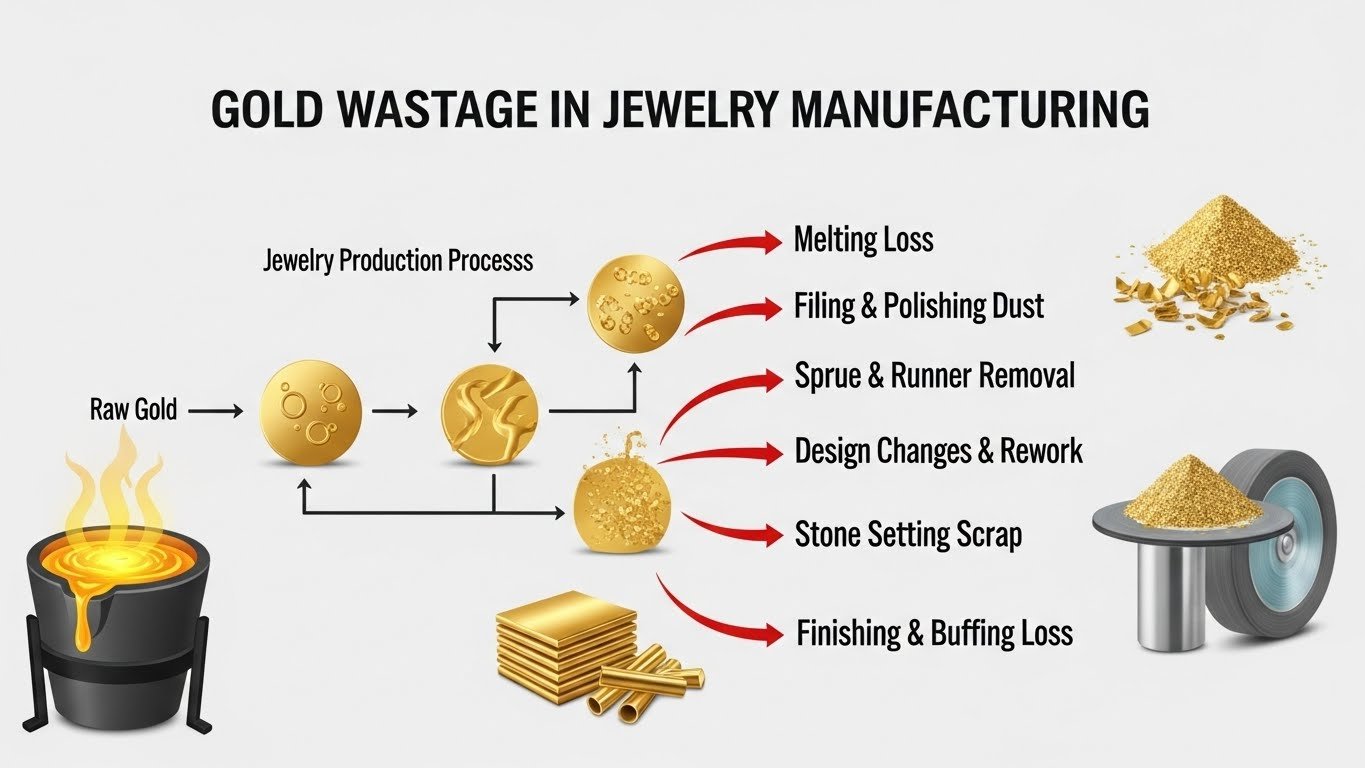
Gold is a soft metal that requires multiple processes to transform raw gold into a wearable jewelry piece. During these processes, small amounts of gold are lost due to filing, polishing dust, sprue cutting, and refining inefficiencies. Manufacturers recover some of this gold, but not all losses are fully reusable, which is why wastage is charged.
In simple terms, gold wastage represents the difference between the gold used in production and the final weight of the finished jewelry.
Why Gold Wastage Exists in Jewelry Making
Gold wastage exists because jewelry manufacturing is not a zero-loss process. Even with advanced technology, some gold loss is unavoidable.
During casting, excess gold is used to ensure proper mold filling. While shaping and polishing, gold dust is generated. In stone-set jewelry, especially diamond jewelry, additional gold is required to create secure prongs, bezels, and structural strength.
Complex designs, handmade jewelry, and intricate detailing increase production steps, which naturally leads to higher wastage. This is why plain gold chains or bangles usually have lower wastage compared to custom diamond rings or detailed bridal jewelry.
How Gold Wastage Is Calculated
Gold wastage is typically calculated as a percentage of the net gold weight used in the jewelry. This percentage is added to the base gold weight before pricing.
For example, if a ring has a net gold weight of 10 grams and the wastage is 8 percent, the chargeable gold weight becomes 10.8 grams. The buyer pays for 10.8 grams even though the finished piece weighs 10 grams.
In some markets, wastage may be charged as a fixed gram value instead of a percentage. Both methods are commonly used, depending on regional practices and the jewelry manufacturer.
Fact 1 Gold Wastage Varies by Jewelry Type
Not all jewelry carries the same wastage. Plain gold jewelry such as bands, chains, and bangles typically has lower wastage because the manufacturing process is simpler.
Diamond jewelry, especially engagement rings and bridal sets, usually has higher wastage due to stone setting, structural reinforcement, and detailed craftsmanship. Jewelry with lab grown diamonds or moissanite may still carry similar gold wastage because the metalwork complexity remains the same.
Custom jewelry manufacturing often involves higher wastage compared to mass-produced designs because of prototyping, multiple revisions, and manual finishing.
Fact 2 Design Complexity Directly Impacts Wastage
The more complex the design, the higher the gold wastage. Intricate patterns, filigree work, pavé settings, and multi-stone designs require additional gold during manufacturing.
Handcrafted jewelry generally has higher wastage than machine-made jewelry because manual processes involve more filing, shaping, and polishing. CAD-based manufacturing helps reduce wastage, but it cannot eliminate it completely.
Buyers should understand that higher wastage does not always mean unfair pricing. In many cases, it reflects genuine craftsmanship and labor intensity.
Fact 3 Gold Purity Affects Wastage
Gold purity plays a role in wastage calculations. Higher-purity gold such as 22K is softer and more prone to loss during processing, which can increase wastage.
Lower-purity gold like 14K or 10K is harder due to alloying metals and may have slightly lower wastage in certain designs. This is one reason why 14K gold jewelry is popular in international markets such as the USA and Europe.
However, purity alone does not determine wastage. Design, craftsmanship, and manufacturing methods are equally important factors.
Fact 4 Stone-Set Jewelry Has Higher Wastage
Jewelry with diamonds, lab grown diamonds, or moissanite generally carries higher gold wastage than plain gold pieces.
Stone settings require extra gold to create secure mounts, prongs, and bezels. Additional gold is also used to ensure durability and long-term wearability, especially in engagement rings and daily-wear pieces.
Even though stones add visual value, the gold structure supporting them contributes significantly to wastage charges.
Fact 5 Handmade Jewelry vs Machine-Made Jewelry
Handmade jewelry typically involves more manual labor, which results in higher gold wastage. Processes such as hand filing, engraving, and polishing create more gold loss compared to automated manufacturing.
Machine-made or CAD-assisted jewelry is more precise and efficient, often reducing wastage percentages. This is why many modern jewelry manufacturers invest in advanced technology to optimize material usage.
Buyers looking to balance craftsmanship and cost should discuss manufacturing methods with their jeweler or supplier.
Fact 6 Wastage Is Different in Retail and B2B Buying
Retail buyers usually encounter higher wastage charges because pricing includes multiple layers such as retailer margins and overhead costs.
In B2B buying, especially when sourcing directly from a jewelry manufacturer, wastage is often more transparent and negotiable. Manufacturers working with wholesalers and brands usually follow standardized wastage structures based on design complexity and order volume.
Businesses sourcing custom gold jewelry manufacturing services often benefit from clearer cost breakdowns and better pricing control.
Fact 7 Wastage Is Often Negotiable
Many buyers assume gold wastage is fixed, but in reality, it can be negotiable, especially for bulk orders or repeat business.
Jewelry brands and wholesalers working directly with manufacturers can often reduce wastage percentages by optimizing designs, choosing efficient manufacturing methods, or increasing order volumes.
Asking for a clear explanation of wastage charges helps buyers make informed decisions and avoid overpaying.
Fact 8 Transparency Matters More Than Low Wastage
Low wastage is not always a sign of a good deal. Unrealistically low wastage may indicate compromised quality, weak structures, or underweight designs.
What matters most is transparency. A trustworthy jeweler or manufacturer will clearly explain how wastage is calculated and why it applies to a specific design.
Brands like Nakassi emphasize transparent pricing and manufacturing clarity, helping B2B buyers understand true production costs rather than hiding them in vague charges.
Fact 9 Regional Practices Influence Wastage Charges
Gold wastage practices vary across regions. In India and the Middle East, wastage is often charged separately and openly. In Western markets, wastage is usually built into the final price and not shown as a separate line item.
International buyers should understand regional pricing structures when sourcing gold jewelry globally to make accurate cost comparisons.
Fact 10 Understanding Wastage Helps You Buy Smarter
Knowing how gold wastage works empowers buyers to evaluate pricing, compare suppliers, and negotiate effectively. It also helps businesses plan pricing strategies, margins, and inventory costs more accurately.
For jewelry brands and wholesalers, understanding wastage is essential for building sustainable supply chains and maintaining profitability.
Final Thoughts
Gold wastage is a fundamental part of jewelry manufacturing that every buyer should understand. It reflects real material loss, craftsmanship effort, and production complexity rather than arbitrary pricing.
By understanding how wastage is calculated, what influences it, and how it varies across designs and markets, buyers can make more informed purchasing decisions and avoid costly surprises.
For B2B buyers sourcing gold jewelry, diamond jewelry, or custom designs, working with a transparent and experienced jewelry manufacturer like Nakassi ensures clarity, consistency, and long-term value across every order.

Priyanka is a jewelry specialist with a passion for crafting stories as dazzling as the gems she adores. With years of experience in the industry, she combines deep expertise in design trends, gemology, and craftsmanship with a flair for creating engaging, informative content that resonates with jewelry enthusiasts and collectors alike.