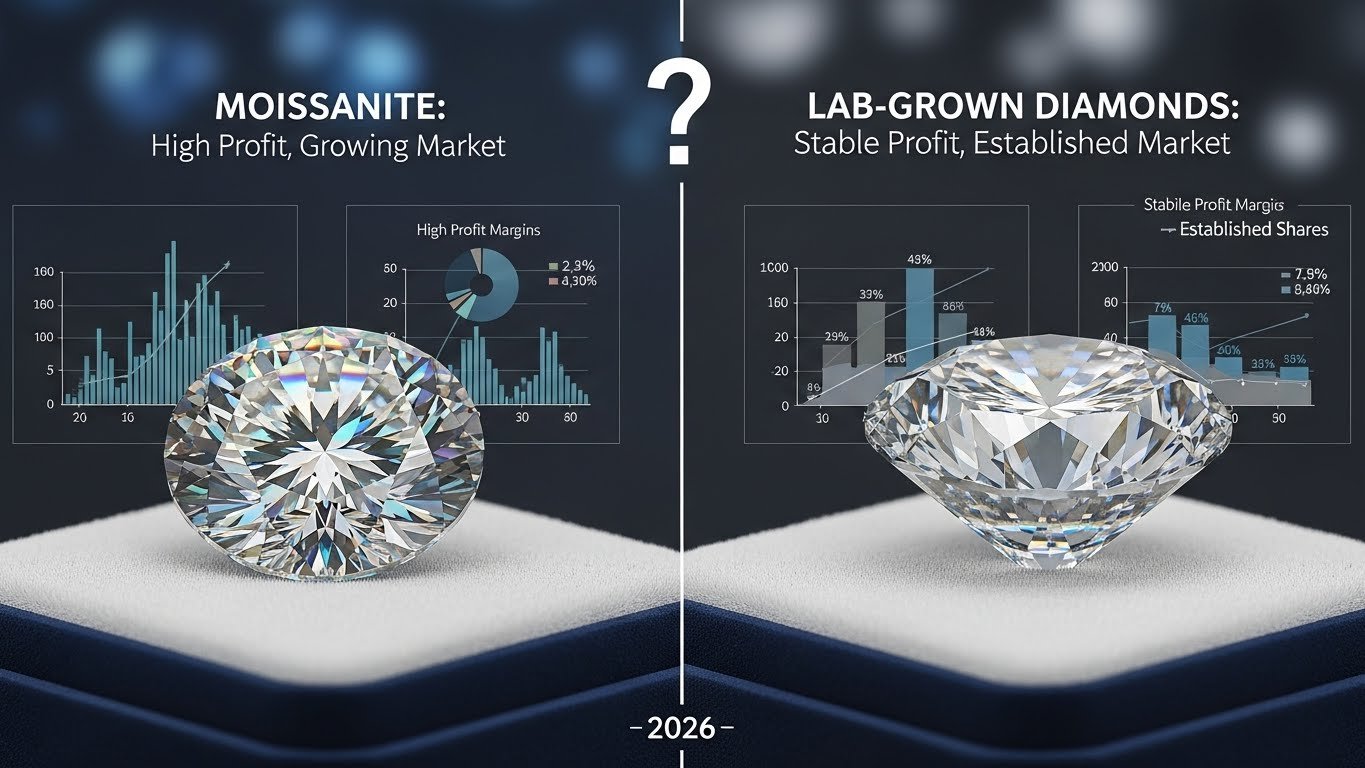
Moissanite vs Lab-Grown Diamonds: Which Is More Profitable for Jewelry Businesses in 2026?
As the jewelry industry evolves in 2026, profitability has become more strategic than ever. Rising customer awareness, ethical sourcing demands, fluctuating gold prices, and tighter margins are pushing B2B jewelry buyers to rethink their gemstone strategy.
Two categories now dominate sourcing conversations globally:
- Moissanite jewelry
- Lab-grown diamond jewelry
Both offer ethical appeal, modern branding advantages, and scalability—but which one delivers higher profit margins for jewelry businesses in 2026?
This guide is written specifically for:
- Jewelry wholesalers
- Retail chains
- DTC jewelry brands
- Private label jewelry buyers
- Startups sourcing from manufacturers
The goal is simple: help you choose the gemstone that aligns best with your margin, branding, and scaling strategy.
Understanding Jewelry Profit Margins in 2026
Before comparing moissanite and lab-grown diamonds, it’s important to understand what drives gemstone profitability in a B2B environment.
Key Profit Margin Factors
- Raw material cost
- Manufacturing complexity
- Certification & grading costs
- Consumer price sensitivity
- Return and remake rates
- Customization potential
- Inventory risk
The gemstone that balances low acquisition cost with high perceived value consistently wins on margins.
What Is Moissanite? A Quick Business Overview
Moissanite is a lab-created gemstone known for its:
- Exceptional brilliance
- High durability (9.25 Mohs)
- Diamond-like appearance
- Affordable production cost
From a sourcing perspective, moissanite has transitioned from a niche stone to a mainstream alternative gemstone, especially in the U.S. market.
Why Moissanite Is Attractive for Jewelry Businesses
- Significantly lower cost than diamonds
- No mining dependency
- Easy availability in multiple cuts and sizes
- Ideal for customization and private label collections
Many brands now work directly with a moissanite jewelry manufacturer to maintain control over quality and pricing.
What Are Lab-Grown Diamonds? A Commercial Perspective
Lab-grown diamonds are chemically and optically identical to mined diamonds but produced in controlled environments.
They appeal strongly to:
- Ethical buyers
- Bridal customers
- Luxury-conscious millennials and Gen Z
Why Lab-Grown Diamonds Are Commercially Viable
- Certified by IGI / GIA-equivalent labs
- Premium perception compared to alternatives
- Accepted widely in engagement and bridal jewelry
- Strong storytelling around sustainability
Brands sourcing from a lab grown diamond jewelry manufacturer gain access to consistent quality without mining volatility.
Cost Comparison: Moissanite vs Lab-Grown Diamonds
Raw Material Cost (Wholesale Level)
| Factor | Moissanite | Lab-Grown Diamond |
| Cost per carat | Very Low | Moderate |
| Price volatility | Minimal | Moderate |
| Supply stability | High | High |
| Certification cost | Optional | Mandatory |
Key Insight:
Moissanite offers significantly lower entry costs, allowing businesses to price aggressively while protecting margins.
Manufacturing & Production Cost Impact
Moissanite Manufacturing
- Easier stone setting
- Lower rejection rates
- Faster production cycles
- Ideal for mass customization
Lab-Grown Diamond Manufacturing
- Higher precision required
- Certification handling
- Stricter quality controls
- Slightly longer turnaround times
For businesses focused on speed-to-market, moissanite offers a clear advantage, especially when working with a custom jewelry manufacturer in India.
Profit Margin Comparison in 2026
Average Gross Margins (B2B Estimates)
| Category | Average Margin |
| Moissanite Jewelry | 60–75% |
| Lab-Grown Diamond Jewelry | 55–70% |
| Custom Moissanite Jewelry | 65–80% |
| Bridal Lab-Grown Jewelry | 60–70% |
While both categories are profitable, moissanite consistently delivers higher margins, particularly in fashion and private label segments.
Consumer Price Sensitivity & Buying Behavior
Moissanite Buyers
- Highly value affordability
- Less certification-driven
- Strong DTC and online demand
- Lower return rates
Lab-Grown Diamond Buyers
- Compare certifications
- More emotionally invested
- Slightly higher price sensitivity
- Higher expectations for after-sales service
From a B2B perspective, moissanite buyers focus on design and value, while lab-grown buyers focus on credibility and symbolism.
Customization & Private Label Potential
Customization is where profit margins multiply.
Moissanite Customization
- Name necklaces
- Engagement rings
- Fashion pendants
- Stackable rings
Lab-Grown Customization
- Bridal rings
- Wedding bands
- High-ticket fine jewelry
Moissanite works exceptionally well under private label jewelry manufacturing and white label jewelry manufacturer models due to low cost and flexible pricing.
Inventory Risk & Scalability
Moissanite
- Low capital lock-in
- Easier SKU expansion
- Ideal for testing new designs
- Faster inventory turnover
Lab-Grown Diamonds
- Higher capital investment
- Slower SKU expansion
- Better suited for curated collections
If your goal is scaling without inventory risk, moissanite offers better operational flexibility.
Best Use Cases by Business Model
Choose Moissanite If You Are:
- Launching a new jewelry brand
- Running a DTC business
- Focused on private label jewelry
- Selling fashion-forward designs
- Working with a jewelry manufacturer for startups
Choose Lab-Grown Diamonds If You Are:
- Targeting bridal buyers
- Selling engagement rings
- Building a premium brand image
- Operating in luxury retail
Many successful brands now offer both, using moissanite for volume and lab-grown diamonds for authority.
Market Trends Supporting Both Categories
Market Signals for 2026
- Moissanite searches continue rising in the U.S.
- Lab-grown diamonds dominate bridal queries
- Ethical sourcing is now expected, not optional
- Lightweight and custom jewelry outperform heavy designs
This trend supports manufacturers offering moissanite engagement rings wholesale, custom engagement ring manufacturer, and lab grown diamond rings wholesale solutions.
Final Verdict: Which Is More Profitable in 2026?
Short Answer:
- Moissanite = Higher margins, faster scale
- Lab-grown diamonds = Premium positioning, strong branding
The most profitable jewelry businesses in 2026 will not choose one over the other—they will strategically use both to balance margin and brand value.
Conclusion: Choosing the Right Manufacturing Partner
Whether you focus on moissanite, lab-grown diamonds, or a hybrid strategy, manufacturing capability and sourcing transparency ultimately determine your profitability.
For B2B buyers seeking expertise in custom jewelry manufacturing, private label jewelry manufacturing, moissanite jewelry production, lab grown diamond jewelry, and gold jewelry manufacturing, Nakassi provides scalable solutions designed to support margin-focused growth in global markets.

Priyanka is a jewelry specialist with a passion for crafting stories as dazzling as the gems she adores. With years of experience in the industry, she combines deep expertise in design trends, gemology, and craftsmanship with a flair for creating engaging, informative content that resonates with jewelry enthusiasts and collectors alike.