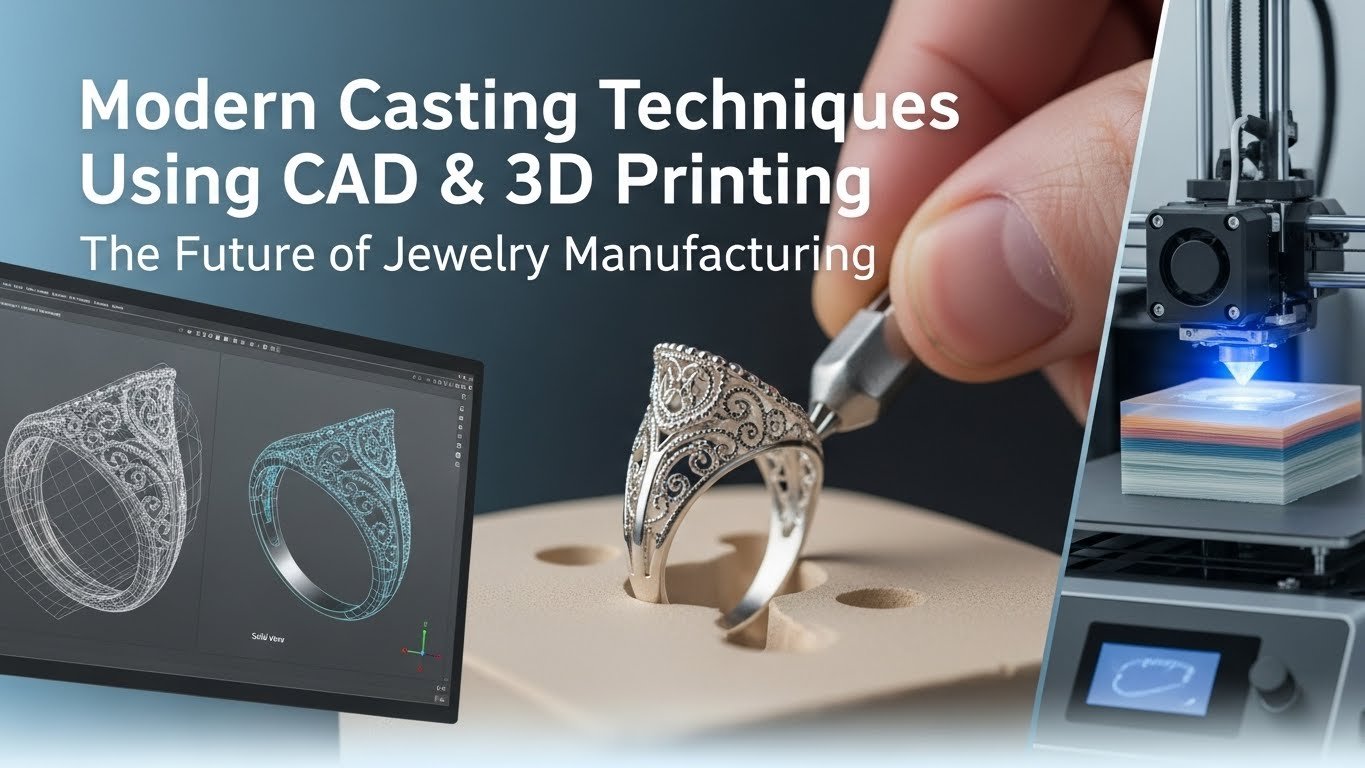
Modern Casting Techniques Using CAD & 3D Printing: The Future of Jewelry Manufacturing
Jewelry has always been a fascinating blend of art and engineering. From the earliest lost-wax methods practiced thousands of years ago to the cutting-edge technologies of CAD design and 3D printing today, the craft of jewelry manufacturing has evolved into a highly precise and efficient process.
For brands, designers, and entrepreneurs exploring how to get jewelry manufactured, understanding modern casting techniques is no longer optional—it’s a requirement. Customers today want bespoke wedding jewelry sets, personalized diamond rings, and custom pearl jewelry that reflect their individuality. To meet this demand, manufacturers are turning to CAD and 3D printing to revolutionize the casting process.
This in-depth guide will help you explore how CAD and 3D printing are transforming jewelry casting, why it matters for your business, and how you can leverage these innovations for your own jewelry line.
1. From Ancient Wax Carving to Digital Precision
The origins of jewelry casting go back over 6,000 years. Early civilizations used the lost-wax casting method, painstakingly hand-carving models in wax before encasing them in clay or stone molds.
Over time, advances like centrifugal casting and vacuum casting improved results, but the process still depended on human skill. Mistakes were common, and complex designs—such as pavé settings or cathedral settings—were nearly impossible to execute perfectly.
The late 20th century brought a seismic shift: Computer-Aided Design (CAD). With CAD, jewelers no longer relied on hand sketches or manual wax carving. Instead, they could digitally build jewelry down to every prong, curve, and stone seat.
By pairing CAD with 3D printing, manufacturers could print highly detailed models in resin or wax. This integration was a game-changer, bridging the gap between design imagination and flawless execution.
2. The Role of CAD in Jewelry Manufacturing
CAD (Computer-Aided Design) is now the foundation of modern jewelry manufacturing. Popular programs like Rhino, MatrixGold, JewelCAD, and ZBrush are widely used by jewelry designers worldwide.
Advantages of CAD in Jewelry Casting
- Design Accuracy – CAD allows exact measurements, ensuring consistency across production. Perfect for understanding prong & shared prong settings where precision is critical.
- Endless Customization – Customers today want bespoke jewelry. With CAD, jewelers can offer custom diamond settings, oxidized jewelry options, and personalized engraving.
- Visualization for Clients – With lifelike renderings, customers see their designs before production, increasing satisfaction and reducing returns.
- Rapid Prototyping – CAD integrates seamlessly with 3D printing, speeding up the prototyping phase.
Whether you’re a custom pearl jewelry manufacturer or a brand specializing in wedding jewelry sets, CAD shortens the design-to-market cycle.
3. 3D Printing: Bringing Designs to Life
Once the CAD model is created, 3D printing steps in to make it real. Unlike manual wax carving, 3D printing offers flawless detail and repeatability.
Popular 3D Printing Technologies in Jewelry
- SLA (Stereolithography) – Produces resin models with ultra-high detail. Perfect for delicate designs like diamond settings for round, oval, princess & emerald cuts.
- DLP (Digital Light Processing) – Faster than SLA, often used for bulk jewelry manufacturing.
- Direct Wax Printing – Creates wax-like models directly compatible with investment casting.
This technology makes it possible to create intricate filigree, hollow structures, and even complex three-stone settings that once required weeks of manual effort.
4. The CAD + 3D Printing Casting Workflow
The modern casting workflow combines ancient techniques with digital precision:
- Designing in CAD – Every detail, from Tiffany settings to custom diamond halos, is digitally modeled.
- 3D Printing – A wax/resin prototype is printed with exact weight and size calculations.
- Investment Casting – The prototype is encased in investment material.
- Burnout – The wax/resin melts away, leaving a perfect mold.
- Metal Casting – Molten metal (gold, silver, platinum, brass, or vermeil) fills the mold.
- Finishing – Skilled artisans polish, file, engrave, and set stones to bring the piece to life.
This blend of digital and traditional craftsmanship ensures efficiency while keeping the artistic essence of jewelry intact.
5. Benefits of Modern Casting Techniques
Precision & Quality
CAD ensures that every prong setting or shared prong band is accurate to the micron. This is crucial for luxury brands where diamond security is non-negotiable.
Cost Efficiency
Less wasted material means lower costs. Brands can experiment with different weights of gold or silver before committing.
Speed
A process that once took weeks can now be completed in a matter of days, allowing faster delivery of wedding jewelry sets or custom engagement rings.
Scalability
Whether you need 1 piece or 1,000, CAD and 3D printing make scaling production easier.
Complex Design Freedom
Intricate lattice structures, hollow interiors, and avant-garde designs are now possible with minimal risk.
6. Jewelry Materials in CAD & 3D Casting
One of the strongest advantages of modern casting is the range of materials available. Jewelers can now experiment across:
- Gold (10K–22K) for luxury fine jewelry.
- 925 Sterling Silver for elegant yet affordable options.
- Platinum for premium, durable wedding bands.
- Brass for affordable fashion jewelry.
- Vermeil (gold-plated sterling silver) as a bridge between fine and fashion jewelry.
CAD ensures precise weight calculations, crucial for brands managing budgets. This is especially important for bulk jewelry casting orders.
7. Real-World Applications for Jewelers
For Startups & Independent Designers
Startups can create custom oxidized jewelry or niche designs like antique-style wedding jewelry sets without high upfront costs.
For Luxury Brands
Heritage houses use CAD for high-value cathedral setting vs. Tiffany setting experiments before finalizing collections.
For Wholesalers
Bulk orders of custom diamond settings or shared prong wedding bands can be produced with unmatched consistency.
For Custom Jewelers
Independent jewelers offering AI-powered jewelry design benefit by giving customers interactive experiences before production.
8. Cost & Time Efficiency in Detail
- Prototyping – 3D printing reduces trial costs; jewelers can test multiple variations of diamond settings for oval cuts or princess-cut engagement rings before casting.
- Lower Risk – Previewing in CAD ensures fewer errors and less metal waste.
- Short Timelines – CAD + 3D printing reduce production time from 3–4 weeks to under 10 days.
- Affordable Entry – Designers don’t need massive budgets to create bespoke jewelry collections.
9. The Global Impact of CAD & 3D Printing
The jewelry industry is deeply global. Designers in New York collaborate with manufacturers in India, Thailand, and Italy seamlessly through CAD file transfers.
- Digital Flexibility – A CAD file for a custom pearl necklace can be printed anywhere in the world.
- Cross-border Collaboration – A U.S. retailer can send files to a custom jewelry manufacturer in India and receive flawless castings.
- Scalable Global Manufacturing – From bespoke orders to wholesale casting, technology bridges time zones and geographies.
This global scalability makes CAD + 3D printing a cornerstone of modern jewelry manufacturing.
10. Challenges & Limitations
- Learning Curve – CAD requires technical training.
- Cost of Technology – High-quality printers and software require investment.
- Post-Processing Needs – Cast pieces still require finishing, polishing, and stone setting.
- Material Residue Issues – Some resins can leave ash in molds if not properly processed.
Yet, with skilled manufacturers, these issues are minimized.
11. The Future of Jewelry Casting
- AI-Powered Design – AI-generated concepts that integrate into CAD for final refinement.
- Direct Metal 3D Printing – Printing in precious metals without molds is on the horizon.
- Sustainability – Recycled gold and lab-grown diamonds paired with CAD efficiency.
- Customer Co-Creation – Interactive design tools where clients modify diamond ring anatomy before production.
12. FAQs
Q1: Is 3D printing only for luxury jewelry?
No. It’s equally effective for oxidized jewelry, custom pearl jewelry, and affordable fashion pieces.
Q2: How does CAD improve customer satisfaction?
Clients can see photorealistic previews of their wedding jewelry sets or engagement rings before casting.
Q3: Which metals work best with CAD + 3D printing?
Gold, silver, platinum, brass, and vermeil are all widely used.
Q4: Does CAD replace artisans?
No. It complements craftsmanship. Stone-setting, polishing, and engraving remain human-driven.
Q5: Can I order bulk casting with CAD files?
Yes. This is why jewelry casting with CAD is preferred by wholesalers and retailers alike.
Conclusion:
The combination of CAD design and 3D printing has transformed jewelry casting into a faster, more precise, and more creative process than ever before. Whether you’re an independent designer exploring custom diamond settings, a wholesaler scaling bulk jewelry casting, or a brand offering wedding jewelry sets, embracing modern casting is the key to success.
At Nakassi, we specialize in turning your ideas into reality through CAD, 3D printing, and world-class jewelry manufacturing. From AI-powered jewelry design to bespoke custom pearl jewelry manufacturing, we help brands and designers bring collections to life with innovation and craftsmanship.
Your vision deserves a trusted partner. Let Nakassi guide you from concept to casting.

Brijesh brings a decade of experience in SEO and a deep love for jewelry to his writing. He excels at creating content that shines both on the page and in search engines, ensuring every story about gems and craftsmanship reaches the right audience.