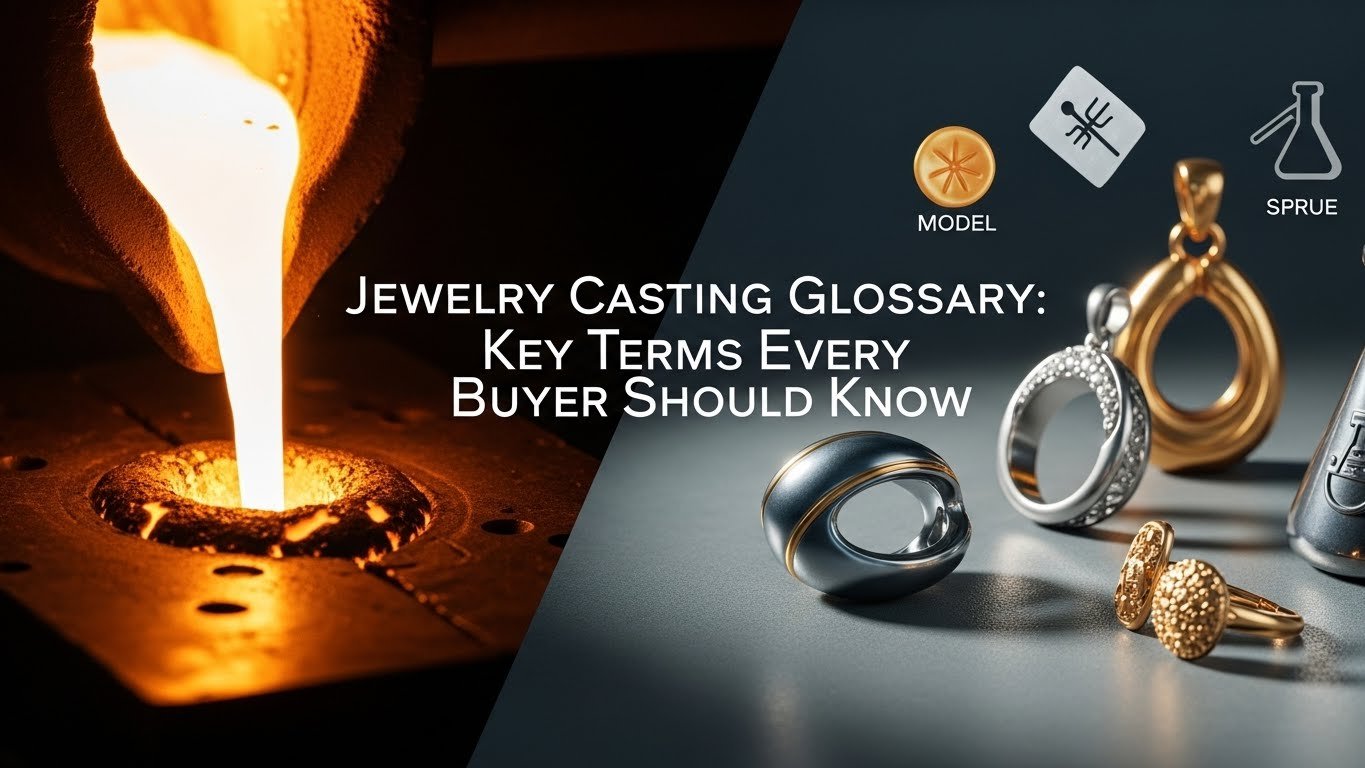
Jewelry Casting Glossary: Key Terms Every Buyer Should Know
If you’re considering working with a jewelry manufacturer for custom or bulk production, understanding the technical language of jewelry casting is essential. Whether you’re a startup brand launching wedding jewelry sets, a designer creating custom diamond settings, or a retailer sourcing 925 sterling silver jewelry, knowing these terms will help you communicate clearly with your casting partner and make informed decisions.
This glossary breaks down the most important terms in jewelry casting, covering everything from CAD design to oxidized jewelry finishes, so you can approach the manufacturing process with confidence.
A–C: Foundational Jewelry Casting Terms
- Alloy – A mix of metals used in jewelry, such as gold alloyed with copper or silver for strength.
- Annealing – The process of heating and cooling metal to make it more workable.
- Bench Jeweler – A skilled artisan who assembles, polishes, or sets stones after casting.
- Brass – A cost-effective metal often used in fashion jewelry or vermeil plating.
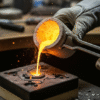
- Burnout – The stage in lost-wax casting where wax is melted out of the mold, leaving a cavity for molten metal.
- CAD (Computer-Aided Design) – A digital design process used to create precise models for jewelry casting. Essential for custom engagement rings, prong settings, and detailed wedding bands.
- Centrifugal Casting – A method that uses centrifugal force to distribute molten metal into molds, often for small-scale production.
- Casting Tree – A structure where multiple wax models are attached to a central sprue, allowing many pieces to be cast at once.
- Cathedral Setting – A type of engagement ring setting where arches of metal rise from the shank to support the stone.
- CNC Milling – Computer-controlled cutting, sometimes used alongside CAD and 3D printing.
D–F: Design & Finishing Terms
- Direct Metal 3D Printing – A modern technique where metal powder is fused layer by layer, useful for prototypes and select fine jewelry.
- Die Striking – A process of stamping metal sheets into shape, less common in custom casting but used for mass production.
- Electroplating – A finishing process where a thin layer of metal (like gold or rhodium) is deposited onto a base metal.
- Enamel – A decorative coating fused onto jewelry, available in transparent or opaque finishes.
- Filigree – Intricate wirework designs often incorporated into custom pearl jewelry or vintage-inspired pieces.
- Filing – The step after casting where excess metal is removed and surfaces are smoothed before polishing.
G–L: Gemstones & Casting Methods
- Gemstone Setting – The method of securing gems into jewelry, such as prong, shared prong, bezel, or tension settings.
- Gating System – Channels that guide molten metal into a mold during casting.
- Gold Vermeil – Sterling silver coated with a thick layer of gold, more durable than standard gold plating.
- Grain – Small pieces of raw metal (gold, silver, platinum) melted during casting.
- Inclusion – Internal imperfections within gemstones, relevant in both natural and lab-grown diamonds.
- Investment – The plaster-like material used to form molds around wax models in lost-wax casting.
- Lab-Grown Diamonds – Ethically produced diamonds, increasingly popular in custom diamond jewelry manufacturing.
- Lost-Wax Casting – The most common jewelry casting technique, where a wax model is replaced by molten metal inside a mold.
M–P: Metals, Prototyping & Settings
- Mold – A hollow form used to shape molten metal. Can be rubber, silicone, or investment plaster.
- MOQ (Minimum Order Quantity) – The smallest production batch a manufacturer will accept.
- Oxidized Finish – A darkened surface finish used in oxidized jewelry collections for an antique or rustic look.
- Pearl Cup – A small setting used to secure pearls in rings, earrings, or pendants.
- Platinum – A durable, premium metal often used in high-end wedding jewelry.
- Polishing – The final step where cast jewelry is smoothed and given its shine.
- Prototyping – The creation of samples using wax, resin, or 3D printing before mass casting.
- Prong Setting – One of the most popular settings for diamonds, where metal claws hold the stone in place. Variations include shared prong settings for multi-stone designs.
Q–T: Quality & Techniques
- Quality Control (QC) – The inspection process ensuring cast pieces match CAD specifications in weight, dimensions, and finish.
- Quenching – Rapid cooling of cast metal in water to solidify it after pouring.
- Rhodium Plating – A finishing process applied to white gold or silver for added shine and durability.
- Ring Shank – The band of a ring, which can be straight, tapered, or designed with details like milgrain.
- Sprue – The channel connecting wax models to the casting tree, allowing molten metal to flow into the mold.
- Stone Setting – The art of securing gemstones; includes prong, bezel, channel, pavé, and halo settings.
- Tiffany Setting – A six-prong setting style made famous by Tiffany & Co., still one of the most elegant engagement ring choices.
U–Z: Advanced & Niche Terms
- Ultrasonic Cleaning – A cleaning method using sound waves in liquid to remove polishing compounds and debris.
- Vacuum Casting – A high-precision casting method where air is removed to reduce porosity and bubbles in the final piece.
- Wax Model – The initial prototype made in wax, later replaced by molten metal during casting.
- Wedding Jewelry Sets – Coordinated bridal jewelry collections, often requiring both casting and hand-finishing expertise.
- XRF Testing – (X-Ray Fluorescence) A technique to verify metal composition.
- Yield – The percentage of usable jewelry after casting, an important factor in cost efficiency.
- Zirconia (Cubic Zirconia) – A lab-created diamond simulant often used in affordable jewelry collections.
Conclusion: Why Jewelry Casting Knowledge Matters
Understanding the language of jewelry casting makes you a more informed buyer and a better partner to your manufacturer. From lost-wax casting and vacuum techniques to prong settings and AI-powered jewelry design, these terms will help you confidently evaluate services, spot red flags, and ensure your designs are produced with precision.
At Nakassi, we combine traditional craftsmanship with modern CAD and 3D printing technology, offering everything from custom pearl jewelry manufacturing to large-scale wedding jewelry casting services. By mastering this glossary, you’ll be ready to collaborate effectively and bring your creative vision to life.

Priyanka is a jewelry specialist with a passion for crafting stories as dazzling as the gems she adores. With years of experience in the industry, she combines deep expertise in design trends, gemology, and craftsmanship with a flair for creating engaging, informative content that resonates with jewelry enthusiasts and collectors alike.