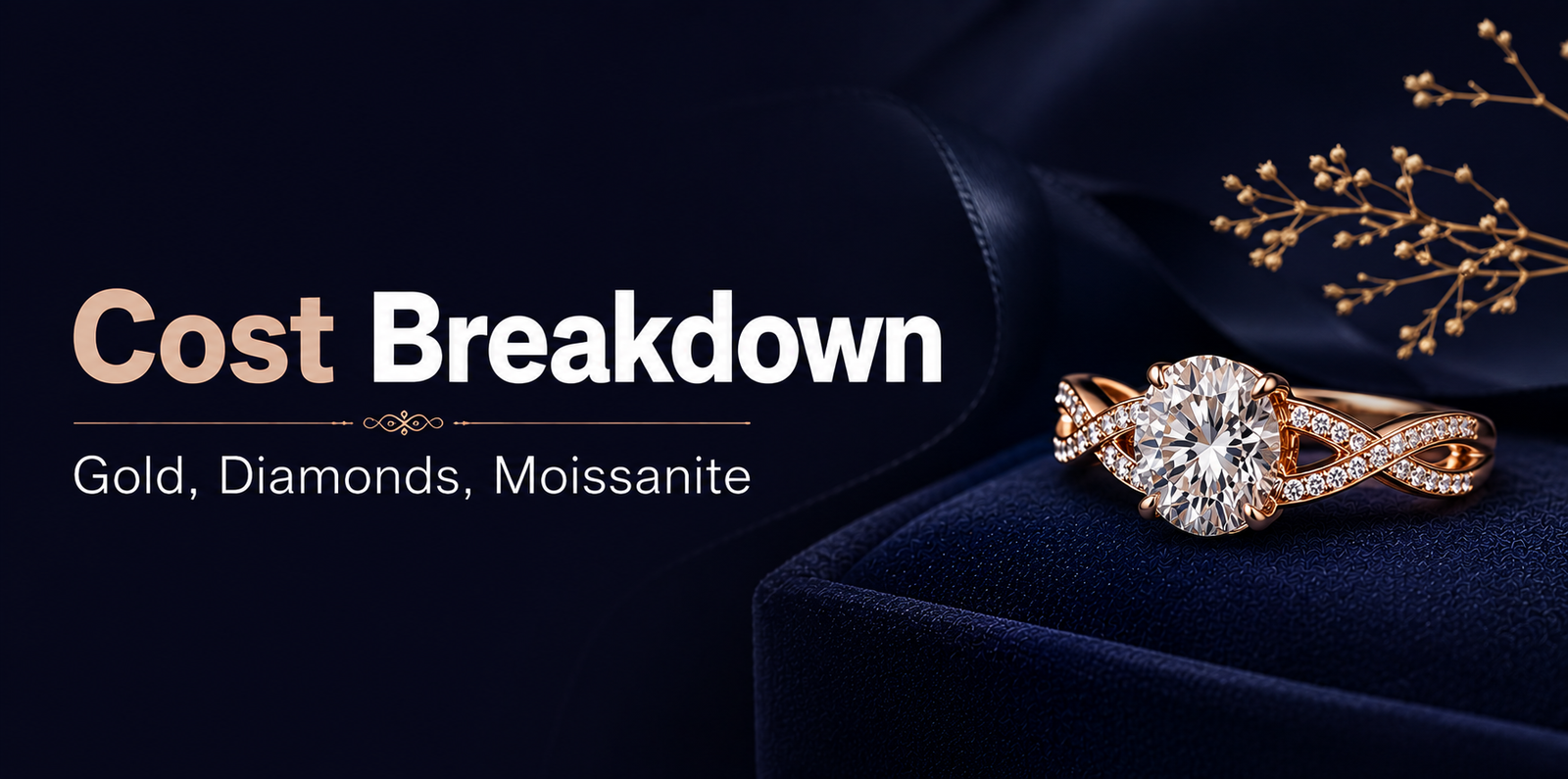
Cost Breakdown: Gold, Diamonds, Moissanite
In hip-hop jewelry, overall pricing is not driven by design alone. The largest cost components come from metal choice, stone selection, and craftsmanship level. Among all materials, gold, diamonds, and moissanite form the core cost structure of most custom chains, pendants, grillz, and iced pieces.
Understanding how each material contributes to total pricing helps buyers make more informed decisions, especially in a market where retail markups and customization charges vary significantly across regions.
Key Takeaway
- Gold is the structural and foundational cost driver
- Diamonds significantly increase pricing due to rarity and grading systems
- Moissanite enables larger, more visually impactful designs at a fraction of diamond cost
- Overall pricing depends on how these three materials are combined in the final design
Gold Cost Breakdown
Gold serves as the structural and financial foundation of most hip-hop jewelry pieces. Its pricing is not fixed and fluctuates based on global market conditions, making it one of the most influential factors in overall jewelry cost. Unlike design elements, gold cost is directly tied to measurable variables such as weight, purity, and international trading rates.
Key Cost Factors
- Purity level (10K, 14K, 18K), where higher karat gold contains more pure gold and increases cost
- Total weight of the jewelry piece, since pricing is calculated per gram
- Daily global gold price fluctuations influenced by international markets and currency value
- Craftsmanship and design complexity, which affects how much gold is required and how it is shaped
Pricing Insight
Different gold purities are used based on budget and durability requirements:
- 10K gold: More affordable option with higher alloy content, offering stronger durability for daily wear
- 14K gold: Balanced choice that combines durability with good visual shine, commonly used in hip-hop jewelry
- 18K gold: Higher purity level with richer color and premium pricing, often used in luxury custom pieces
Gold pricing typically forms a significant portion of the total jewelry cost structure. Even small changes in weight or purity level can noticeably impact the final price, especially in heavy chains, iced pendants, and custom-designed pieces where material usage is high.
Gold remains the base cost driver in hip-hop jewelry, and understanding its pricing structure is essential for making informed customization decisions.
Diamond Cost Breakdown
Diamonds are one of the highest-value components in traditional hip-hop jewelry due to their rarity, strict grading systems, and strong association with luxury positioning. Unlike metals, diamond pricing is highly sensitive to quality differences, meaning even small variations in grading can significantly impact the final cost of a piece.
Key Cost Factors
- Carat size and total stone weight used in the design
- Clarity, cut quality, and color grading based on certification standards
- Natural diamonds versus lab-grown diamonds, which differ significantly in pricing
- Stone setting complexity, especially in fully iced or intricate designs
Pricing Behavior Overview
Diamond pricing does not follow a linear structure. Instead, it increases exponentially with size and quality. Larger stones and higher-grade diamonds become disproportionately more expensive due to rarity and grading standards.
- Small diamond accents: Moderate cost increase, mainly used for detailing
- Fully iced diamond pieces: High cost due to large stone quantity and labor
- Larger individual stones: Sharp price escalation due to rarity and certification premiums
Diamond Cost Comparison Table
| Diamond Type / Usage | Cost Impact Level | Key Reason |
| Small diamond accents | Low to moderate | Used for detailing, low total carat weight |
| Partial iced designs | Moderate | Balanced stone usage with controlled coverage |
| Fully iced chains / pendants | High | High stone quantity and labor-intensive setting |
| Large single-stone pieces | Very high | Rarity and exponential per-carat pricing increase |
| Premium graded natural diamonds | Extremely high | Certification, clarity, and rarity premiums |
Diamond pricing increases sharply as carat size grows because higher-quality and larger stones are significantly rarer in the global market. This creates a non-linear pricing structure where bigger stones can cost disproportionately more per carat compared to smaller ones.
Moissanite Cost Breakdown
Moissanite has become one of the most important materials in modern hip-hop jewelry because it delivers high visual impact at a significantly lower cost compared to diamonds. It is widely used in fully iced chains, pendants, watches, and custom pieces where brightness, coverage, and camera visibility are priorities.
Unlike traditional gemstones, moissanite pricing is driven more by design execution and coverage area rather than rarity or grading systems, making it a more predictable and scalable option for custom jewelry production.
Key Cost Factors
- Stone size and total coverage area, which directly affects the overall iced look and material usage
- Cut quality and precision setting, which determines how well the stone reflects light and maintains symmetry
- Design density, including whether the piece is fully iced, half-iced, or minimally accented
- Complexity of stone placement, especially in custom logos, name pendants, and detailed patterns
Pricing Advantage
Moissanite offers a clear cost advantage in hip-hop jewelry manufacturing:
- Significantly lower cost compared to diamonds at similar visual scale
- Allows larger stone coverage within the same budget, enabling more bold and fully iced designs
- Reduces overall production cost for high-visibility pieces without compromising shine performance
- Makes custom luxury-style jewelry more accessible to a wider range of buyers
Moissanite Cost Comparison Table
| Moissanite Usage Type | Cost Level | Key Advantage |
| Small accent stones | Low | Budget-friendly detailing |
| Partial iced designs | Moderate | Balanced shine and cost efficiency |
| Fully iced chains/pendants | Moderate to high | Large visual impact at lower cost than diamonds |
| Heavy custom logo designs | Variable | Depends on design complexity and stone density |
| High-coverage statement sets | High (relative) | Maximum sparkle with controlled budget |
Moissanite can deliver approximately 80%–90% cost savings compared to diamonds, while offering higher light refraction, resulting in stronger sparkle and improved visibility under LED lighting, flash photography, and video content environments.
Comparative Cost Structure
In hip-hop jewelry, overall pricing is built on a layered material structure rather than a single cost factor. Gold, diamonds, and moissanite each play a different role in determining the final price, and their impact changes based on design complexity, coverage level, and market positioning.
Gold determines the base value of the jewelry
Gold forms the structural foundation of most pieces and establishes the starting cost of production. Its value is driven by weight, purity, and global market rates, making it the most consistent cost component across all designs. Whether the piece is minimal or heavily iced, gold defines the baseline pricing level.
Diamonds define luxury pricing and exclusivity
Diamonds significantly elevate the overall cost due to grading systems, rarity, and certification requirements. They are typically used in premium or investment-focused pieces where exclusivity and long-term value are priorities. As diamond usage increases in a design, pricing scales rapidly due to non-linear cost growth based on carat and quality.
Moissanite drives affordability and visual scale
Moissanite plays a key role in modern hip-hop jewelry by enabling larger and more visually intense designs at lower cost. It allows full iced coverage, strong sparkle under lighting, and high-impact aesthetics without the financial burden associated with diamonds. This makes it a preferred choice for fashion-driven and content-focused jewelry.
Final Insight
In 2026, hip-hop jewelry pricing is increasingly shaped by material strategy rather than design complexity alone. The final cost of a piece is determined less by how it looks and more by what it is made of, how much material is used, and how each component—gold, diamonds, or moissanite—is selected and combined.
Buyers who understand this structure are better positioned to control their budget while still achieving strong visual impact. Gold defines the base value of the piece, diamonds significantly increase pricing due to grading and rarity, while moissanite offers a cost-efficient way to achieve maximum brilliance and larger iced designs without the high expense associated with natural stones.
As the market becomes more transparent and globally connected, individuals are also moving away from retail-heavy pricing models. Instead of paying for branding, showroom overheads, and multiple distributor layers, many buyers now prefer direct access to manufacturing.
For individuals seeking clearer pricing, full customization control, and flexibility in material selection, direct manufacturing solutions such as Nakassi allow greater transparency in gold purity, stone selection, and overall design execution. This approach helps eliminate unnecessary retail markups while enabling more precise control over both cost and final jewelry outcome.
FAQs
1. What is the biggest cost factor in hip-hop jewelry: gold or stones?
In most cases, both matter, but gold forms the base cost because it is required in every piece. However, diamonds can sometimes exceed gold cost depending on carat weight, quality, and coverage in iced designs.
2. Why does gold price change the total jewelry cost daily?
Gold is a globally traded metal, and its price changes daily based on international market rates, currency value, and demand. Since jewelry is priced based on weight, even small price changes in gold affect final cost.
3. Is moissanite pricing fixed or does it vary like diamonds?
Moissanite pricing is more stable than diamonds because it is lab-created and not dependent on mining scarcity or grading systems. However, cost still varies based on size, cut quality, and setting complexity.
4. Why do iced-out pieces cost more even with the same material?
Iced designs require more stones, more labor for setting, and higher precision work. This increases production time and making charges, even if the base material remains the same.
5. Does gold purity affect durability in hip-hop jewelry?
Yes. Lower karat gold like 10K is more durable due to higher alloy content, while higher karat gold like 18K is softer but more premium in appearance. This also impacts long-term wear behavior.
6. Why are diamond grillz more expensive than moissanite grillz?
Diamond grillz are priced higher due to stone grading, rarity, and certification requirements. Moissanite grillz achieve a similar visual effect at a significantly lower cost because they do not follow the same grading system.
7. Do moissanite stones lose shine over time?
Moissanite maintains its brilliance for long periods when properly cleaned and maintained. Unlike lower-grade stones, it does not dull quickly under normal wear conditions.
8. Why do custom hip-hop chains cost more than ready-made chains?
Custom chains involve CAD design, mold creation, personalized sizing, and additional labor. This customization process increases production time and making charges compared to mass-produced designs.
9. Is diamond investment better than moissanite in jewelry?
Diamonds generally hold higher resale and investment value due to market demand and grading systems. Moissanite is primarily used for fashion and visual impact rather than investment purposes.
10. How can buyers identify if jewelry is overpriced?
A major indicator is excessive branding or retail markup compared to material value. Similar designs with different price tags often indicate differences in sourcing, not quality. Direct manufacturing pricing usually provides better cost transparency.